
Saphire Happy Chews Review: Are These Saffron Gummies Worth Considering?
Why This Product Caught My Attention
I spend a fair amount of time exploring products that promise to make everyday life a little easier. Some are clever home gadgets, others are skincare discoveries, and occasionally I come across something in the wellness category that makes me curious enough to dig deeper.
Saphire Happy Chews was one of those products.
What initially caught my attention wasn’t a dramatic before-and-after story or an impressive-looking statistic. It was the concept itself: a saffron-based gummy designed with children’s daily routines in mind.
Saffron is an ingredient I usually associate with cooking, rather than children’s supplements. Seeing it positioned as an ingredient for focus and emotional well-being made me curious.
I wanted to understand what was actually inside the product, how the brand presents it, and whether the scientific evidence is as convincing as the marketing suggests.
After spending time researching Saphire, I think there are some genuinely interesting details worth discussing. There are also several questions I would want answered before purchasing it for a child.
Here’s my closer look.
First Impressions: Friendly Packaging That Feels Approachable
One of the first things I noticed about Saphire Happy Chews was the packaging.
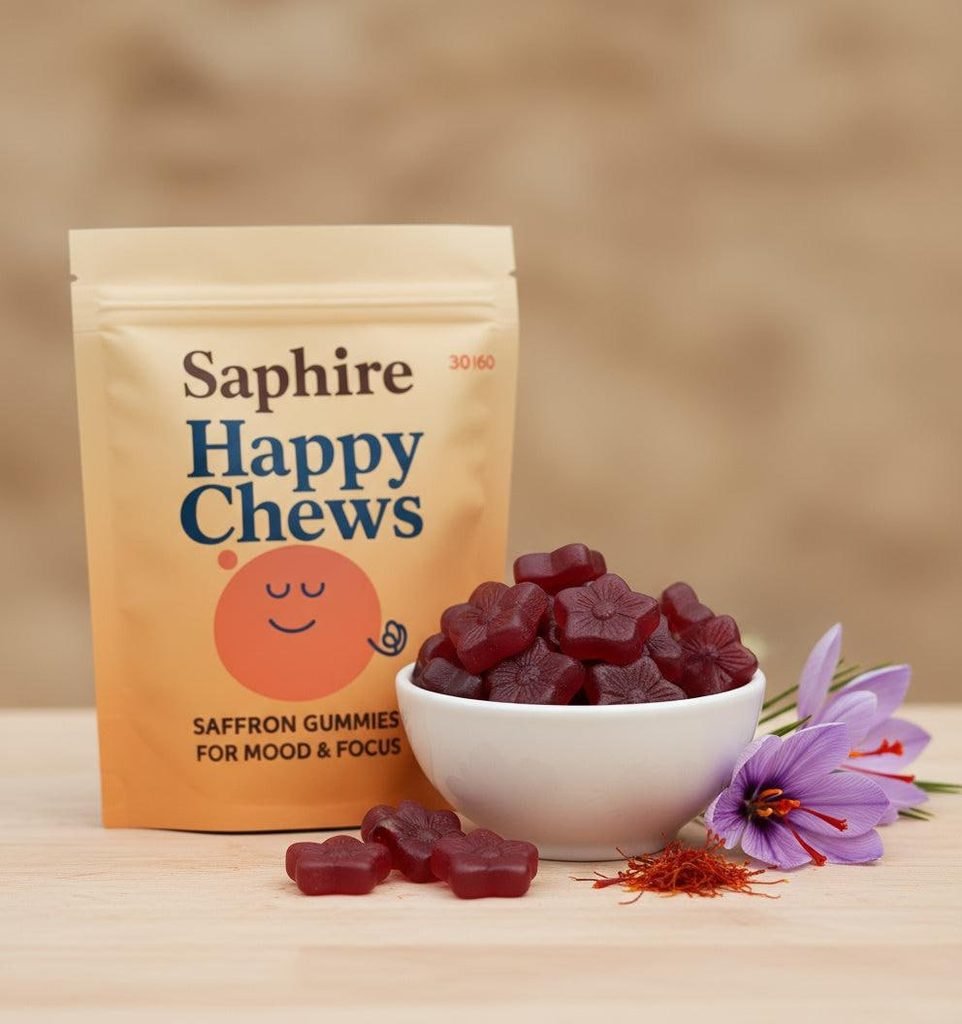
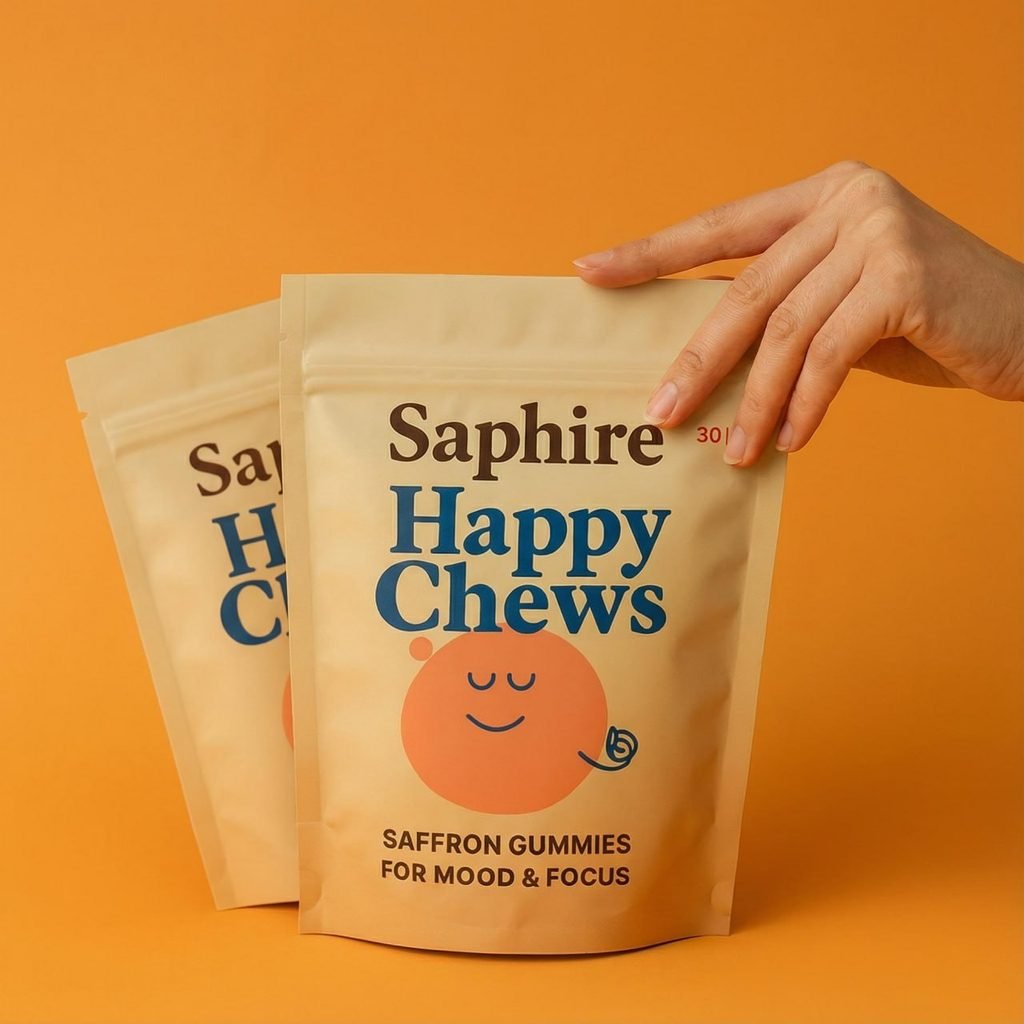
The brand has chosen a soft beige background, blue lettering, and a simple orange smiling-face illustration. It’s cheerful without being overly childish, and it has a clean, modern look.
Personally, I prefer this type of packaging to supplement labels crowded with medical-looking graphics, complicated ingredient claims, and exaggerated promises.
The resealable pouch format also seems practical. It looks easy to store in a kitchen cabinet or keep alongside other household wellness products.
Of course, attractive packaging doesn’t tell us whether a supplement works.
But it does tell us something about the brand’s approach: Saphire wants its product to feel like an approachable part of an everyday family routine.
There’s one important distinction, though. When a supplement resembles candy, safe storage becomes especially important. Children shouldn’t have unrestricted access to the pouch, and the product should never be treated as an ordinary snack.
What Exactly Are Saphire Happy Chews?
Saphire Happy Chews are dietary supplement gummies marketed primarily toward parents looking for nutritional support related to children’s focus, mood, and emotional regulation.
The brand identifies saffron as its signature ingredient.
Saffron comes from the flower Crocus sativus. Although it is best known as an expensive culinary spice, extracts from saffron have also been investigated in studies involving mood and attention.
That research is an interesting starting point, but it’s important to separate studies on saffron extracts from evidence about a particular commercial gummy.
They are not automatically interchangeable.
A product’s effects can depend on its formulation, extract standardization, dose, additional ingredients, and the population taking it.
That’s why I wouldn’t evaluate Saphire based solely on its references to saffron research.
I would also want to see how the product’s specific ingredients and doses compare with the formulations studied in clinical trials.
The Ingredient Story: What Makes Saffron Interesting?
For me, the ingredient research is the most interesting part of this product.
Saffron contains naturally occurring compounds such as crocin, crocetin, and safranal. Researchers have studied these substances for a range of potential biological effects, including their possible relationship with mood and neurological function.
Some small clinical trials have explored saffron extracts in people with attention-deficit/hyperactivity disorder (ADHD).
A systematic review published in the Journal of Attention Disorders in 2024 examined four studies involving 118 participants. The review described promising preliminary findings, while emphasizing the need for better-designed, larger research studies.
I think that’s an important distinction.
Promising research is encouraging, but it isn’t the same as having enough evidence to promise a particular result for every child.
It also doesn’t mean that a supplement can replace prescribed medication, behavioral interventions, educational support, or professional medical care.
Saphire’s marketing puts considerable emphasis on saffron’s potential benefits. I understand why: a recognizable botanical ingredient with some clinical research behind it is an appealing concept.
But as a shopper, I would still want independent evidence showing that the exact finished Saphire formulation delivers measurable benefits.
How Does Saphire Compare With Ordinary Kids’ Gummies?
One reason this product stands out is that it isn’t marketed as a conventional multivitamin.
Many children’s gummies focus on familiar nutrients such as vitamin C, vitamin D, or zinc. Saphire, by contrast, is positioned around mood and attention-related concerns.
That makes the brand different from typical daily vitamin products, but it also raises the standard of evidence I would expect.
If a supplement is intended simply to help address a demonstrated nutritional deficiency, the evaluation can be relatively straightforward.
A product marketed around attention, emotional regulation, and behavioral changes is more complicated.
Those challenges can have many possible causes, including sleep difficulties, stress, learning differences, developmental conditions, environmental factors, or medical concerns.
A gummy can’t determine which of those factors is affecting a particular child.
For that reason, I see Saphire as a specialty supplement that requires more careful consideration than an ordinary wellness purchase.
The concept is interesting, but the context matters.
What I Think About the Brand’s Approach
After browsing Saphire’s website, I noticed that the brand places a strong emphasis on the emotional side of parenting.
Its product descriptions frequently reference difficult mornings, homework struggles, school-related concerns, and the stress that can come with supporting a child through behavioral challenges.
Those situations are relatable, and I can understand why parents might be drawn to a product that sounds simple and manageable.
At the same time, I think wellness marketing needs to be especially careful when it speaks to parents who may already be worried about their children.
A good supplement brand should help consumers understand what is known, what remains uncertain, and what results they can reasonably expect.
It shouldn’t make families feel that purchasing a product is the missing piece in solving complicated behavioral or developmental concerns.
That balance between accessibility and evidence is something I always look for when reviewing wellness products.
What About the Customer Reviews?
Saphire’s website displays numerous positive customer testimonials, including accounts from parents who say they noticed changes in their children’s routines or behavior.
The brand also features ratings and customer-satisfaction figures.
I don’t think customer feedback should be ignored. Reviews can provide useful insights into taste, convenience, shipping experiences, and what shoppers liked or disliked.
However, testimonials aren’t equivalent to clinical evidence.
They are individual accounts, generally without the controls needed to determine whether a product caused a specific change.
For example, a child might experience changes in sleep, attention, or behavior because of developments at school, adjustments to family routines, other interventions, or natural variation over time.
It’s difficult to isolate the effect of a supplement from a single review.
For me, the most useful reviews would be those that discuss practical details: whether children liked the taste, how easy the packaging was to use, and whether the company handled customer service questions professionally.
Claims about major improvements in ADHD symptoms deserve a higher level of scrutiny.
The Convenience Factor: Why Gummies Appeal to Families
I can see why Saphire chose a gummy format.
Some children dislike capsules, tablets, or powders. Others are sensitive to strong flavors or unfamiliar textures.
A chewable supplement may be easier for some families to incorporate into an established routine.
And unlike products requiring measuring spoons or complicated preparation, gummies can offer a straightforward format when used under adult supervision.
That doesn’t guarantee a child will enjoy the flavor, of course.
Taste preferences are personal, and without firsthand testing I can’t confirm the texture, sweetness, or aftertaste of Happy Chews.
I would also want parents to check the full ingredient panel for allergens, sweeteners, and other components relevant to their child’s needs.
The convenience of a gummy is a practical advantage, but it should never outweigh questions about suitability and safety.
What I Would Check Before Giving It to a Child
If I were evaluating this product for a family member, there are several things I would want to verify before making a decision.
The first would be the exact ingredient list on the package being shipped.
Supplement formulas can change, and it’s essential to know not only the active botanical ingredient but also any additional herbs or compounds included in the formula.
I would also want to know the amount and standardization of the saffron extract, the recommended age range, and how those details compare with published research.
Next, I would ask about independent testing. Saphire states that its products undergo third-party testing, which is a positive claim in principle.
But I would want a recent certificate of analysis corresponding to the product batch, rather than relying on a general statement about quality control.
Finally, I would discuss the supplement with a pediatrician or qualified healthcare professional, especially if the child takes medication or has an existing medical or developmental condition.
This isn’t an area where I think guesswork is appropriate.
Is Saphire Happy Chews a Replacement for ADHD Medication?
This is a question I think deserves a very clear answer.
No. Saphire Happy Chews should not be treated as an established substitute for ADHD medication or other evidence-based treatments.
The research into saffron is still relatively limited, and results from studies of specific extracts do not prove that every saffron supplement has comparable effects.
There also isn’t enough product-specific evidence to assume that Saphire can provide the same benefits as prescribed treatments.
Likewise, a product being described as natural doesn’t automatically make it free of adverse effects or medication interactions.
If a child is already receiving treatment, any proposed addition or change should be discussed with their clinician.
I would be especially cautious about marketing that suggests supplements can make prescription treatment unnecessary.
Good healthcare decisions should be individualized and supported by qualified professionals, not driven by a testimonial or a product advertisement.
Pricing: Is This an Affordable Wellness Product?
At the time of my research, Saphire’s online catalog displayed Happy Chews products in the approximately 50–55 range, with some bundle options available.
That places the product above the price of many ordinary children’s gummy supplements.
Whether the price is reasonable depends on what someone expects from it.
If a product delivers a clear, measurable benefit supported by high-quality research, a premium price may be easier to justify.
But with Saphire, I would want more information about the exact formulation and product-specific evidence before concluding that the higher cost represents good value.
The brand also advertises a 60-day money-back guarantee, which initially sounds reassuring.
However, there is an important detail shoppers should know: its published refund policy says standard returns must be unopened and unused, with customers responsible for return shipping.
That is more restrictive than the impression created by some of the brand’s risk-free trial messaging.
I would definitely read the full policy and clarify the conditions with customer support before purchasing.
The Things I Like About Saphire
There are a few aspects of the brand that I genuinely find appealing from a product-review perspective.
First, the packaging looks thoughtfully designed. It’s recognizable, cheerful, and fairly minimalist.
Second, the decision to build a product around saffron gives the brand a distinctive identity in a crowded supplement market.
Third, I appreciate that saffron has attracted legitimate scientific interest. Even though the evidence is preliminary, it makes the ingredient worth researching rather than dismissing outright.
Fourth, the gummy format could be convenient for families who have difficulty with traditional supplement forms.
And finally, the company provides public contact information and a published return policy, allowing shoppers to investigate the brand before ordering.
These are worthwhile positives, although none of them independently establish clinical effectiveness.
What Makes Me Hesitate
My main hesitation isn’t the packaging, the concept, or even the premium pricing.
It’s the gap between the strength of some marketing messages and the amount of publicly available product-specific evidence.
The brand makes confident claims about improvements in focus, mood, and family routines. Those claims are compelling, but they need careful substantiation.
I’d also like greater clarity around formulation differences across the website’s listings and marketing materials.
When a product is intended for children, consistency and transparency matter enormously.
Another concern is the refund policy. I think shoppers should be able to understand any limitations immediately, rather than discovering them after becoming interested in a risk-free offer.
These concerns don’t necessarily mean the product is poor quality. They simply mean I don’t yet have enough information to give it an enthusiastic recommendation.
Who Might Want to Research Saphire Further?
Saphire may interest parents who are already exploring nutritional supplements with their child’s healthcare professional and want to learn about saffron-based formulations.
It may also appeal to people interested in emerging botanical supplement research.
But I wouldn’t recommend buying it simply because a child struggles with concentration, emotional regulation, sleep, or behavior.
Those symptoms can warrant professional assessment, and the right support will depend on the individual child.
I’d also avoid purchasing it on the assumption that it will produce the same results described in the most enthusiastic customer testimonials.
Individual outcomes are uncertain, and the scientific evidence remains limited.
My Final Verdict: Interesting Concept, But More Evidence Is Needed
After researching Saphire Happy Chews, my opinion is mixed.
I like the branding. I like the straightforward gummy concept. And I think saffron is an interesting ingredient with a developing research base.
But when a supplement is marketed for children and connects its benefits to attention and emotional well-being, my expectations for transparency become much higher.
I want clear ingredient information, independent quality testing, sensible medical guidance, and realistic claims.
Saphire has created a product that stands out visually and commercially. Whether it stands out clinically is a separate question.
Would I recommend it?
I would recommend researching the product carefully and discussing it with a child’s healthcare professional before considering a purchase.
I wouldn’t recommend treating it as a proven solution for ADHD or behavioral concerns, and I wouldn’t rely on promotional testimonials as evidence of effectiveness.
Ultimately, Saphire Happy Chews is a brand worth examining with curiosity, but also with a healthy amount of skepticism.
And for me, that’s what a useful product review should offer: not just reasons to buy something, but enough information to make a thoughtful decision.
Official website: https://trysaphire.com
Review disclosure: This article reflects independent research and editorial impressions, not firsthand product testing. Prices, formulations, and policies may change. If affiliate links are included, the publisher may earn a commission from qualifying purchases at no additional cost to the reader.
Medical disclaimer: This article is for informational purposes only and does not provide medical advice. Dietary supplements are not substitutes for professional assessment or prescribed treatment. Consult a qualified healthcare professional before giving a child any new supplement.