

After testing dozens of smartwatches, these are the ones that impressed us the most. From Apple and Samsung to OnePlus and more, here are our top picks to match your budget, lifestyle and phone.
Smartwatches have graduated from being nice-to-have phone companions to standalone health tools on our wrist. They can help you track your vitals, monitor sleep, coach you through workouts, and give you a much-needed break from your phone by delivering the essential notifications without the temptation of a full-screen experience. Whether you’re team iPhone or team Android, we’ve tested and vetted the best smartwatches for you based on prices, features and design.
Our Picks
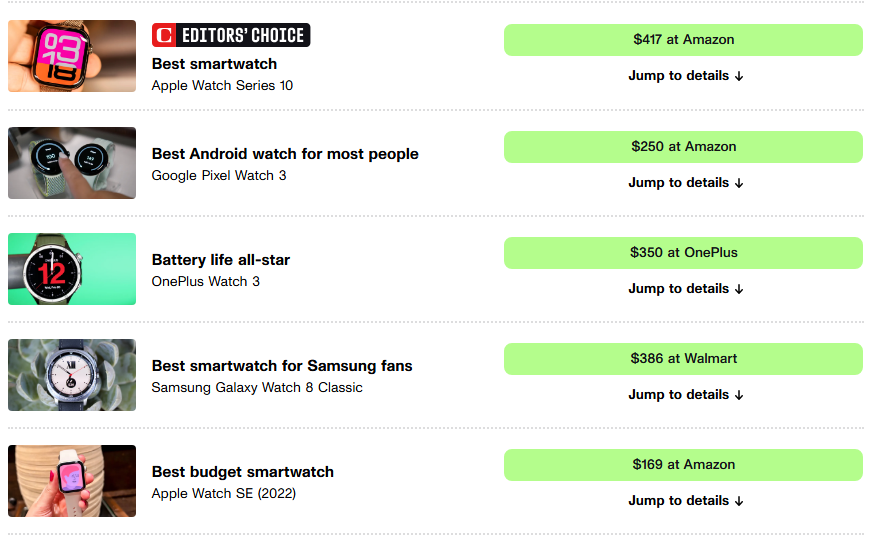
Generally, premium models deliver seamless integration and advanced tools, while budget-friendly picks get you the essentials with a few trade-offs. The common denominator: Every watch on this list has been rigorously tested, so you can be confident you’re getting great value no matter which one you choose. Here are our top recommendations for the best smartwatches in 2025.
What is the best smartwatch?
The Apple Watch Series 10 is our favorite overall smartwatch. It combines polished software with a wide variety of health tools and smartphone companion features. Ten years after the original Apple Watch set the stage for the modern smartwatch, the Apple Watch Series 10 adds even more health-tracking features including sleep apnea notifications and practical smartwatch tools like voice isolation for clearer calls. If you’re an iPhone owner, the Series 10 provides the right balance of features for the price.
The Apple Watch Series 10 isn’t perfect. Battery life still only lasts about one to two days with light use. Fast charging goes some way to address battery life, but it still means the watch is off your wrist more than you might like. Considering the health and safety tools, from fall detection during the day, to sleep apnea notifications at night, you are likely to want to wear the watch as much as possible. The Apple Watch Series 10 has the right balance of health tracking and everyday usability to make it the best choice.
Best smartwatches compared
See how all the smartwatches measure up when it comes to the specs.
| Apple Watch Series 10 | Google Pixel Watch 3 | One Plus Watch 3 | Samsung Galaxy Watch 8 Classic | Apple Watch SE (2nd Gen) | Amazfit Bip 6 | Apple Watch Ultra 2 | Garmin Venu 3 | |
|---|---|---|---|---|---|---|---|---|
| Shape | Square | Round | Round | Squircle (round Screen, square frame) | Rectangular | Square | Square | Round |
| Watch size | 42mm, 46mm | 41mm, 45mm | 47mm | 46mm | 40mm, 44mm | 50mm | 49mm | 41mm, 45mm |
| Materials, finishes | Aluminum, titanium | Aluminium | Titanium bezel, stainless steel case, sapphire crystal glass | Stainless Steel | Aluminum, Midnight, Starlight, Silver | Aluminium, fiber polymers | Titanium | Stainless steel |
| Display size, resolution | 42mm: 1.65-inch OLED 446 x 374 pixels; 46mm: 1.81-inch 496 x 416 pixels | 41mm: 1.61-inch 320 ppi, AMOLED; 45mm: 1.77-inch 320ppi AMOLED | 47mm: 1.50-inch LTPO AMOLED, 466 x 466 pixels | 1.34-inch Super AMOLED 438 x 438 | 40mm: 324 x 394, 44mm: 368 x 448 | 1.97 in (50mm) AMOLED; 390×450 pixels | 1.91-inch, 502 x 410-pixel OLED | 1.4-inch, 454 x 454-pixel AMOLED |
| Dimensions | 42mm: 42 x 36 x 9.7mm; 46mm: 46 x 39 x 9.7mm | 41mm: 41 x 41 x 12.3 mm; 45mm: 45 x 45 x 12.3 mm | 46.6mm(excluding lugs)*47.6mm*11.75mm(excluding sensor area) | 46.0 x 46.4 x 10.6mm | 40mm: 40 x 34 x 10.7 mm, 44mm: 44 x 38 x 10.7 mm | 46.3 x 40.2 x 10.45mm | 44mm x 49mm x 14.4mm | 45mm: 45 x 45 x 12 mm |
| Weight | 42mm (Wi-Fi): 30 g; 42mm (cellular): 29.3 g; 42mm (titanium): 34.4 g; 46mm (Wi-Fi): 36.4 g; 46mm (cellular): 35.3 g; 46mm (titanium): 41.7 g | 41mm: 31g; 45mm: 37g | ~80g with strap | 63.5g | 40mm GPS: 26.4g, 40mm Cellular: 27.8g, 44mm GPS: 32.9g, 44mm Cellular: 33g | 27.9g | 61.4g | 30g |
| Colors | Jet black, rose gold, silver; titanium: slate, gold, natural | Matte Black, Polished Silver, Matte Hazel | Obsidian Titanium, Emerald Titanium | White, Black | Midnight, Starlight, Silver | Black, charcoal, stone, red blush | Natural titanium | Whitestone/silver, black/slate |
| Always On | Yes | Yes | Yes (LTPO enables low-power AOD) | Yes | No | Yes | Yes | Yes |
| Interchangeable bands | Yes | Yes | Yes (22mm standard) | Yes | Yes | Yes | Yes | Yes |
| GPS | Yes | Yes | Yes (Dual-band L1 + L5) | Yes (Dual-band) | Yes | Yes | Yes (L1 and L5) | Yes |
| Automatic workout detection | Yes | Yes | Yes | Yes | Yes | Yes | Yes | Yes |
| Compass | Yes | Yes | Yes | Yes | Yes | Yes | Yes | Yes |
| Altimeter | Yes | Yes | Yes | Yes | Always-on altimeter | No | Yes (operating range: -500m to 9,000m) | Yes |
| Water/Dust resistance | Water resistant up to 50m (5ATM), IP6X (dust) | Water resistant up to 50m (5ATM), IP6X (dust) | Water resistant up to 50m (5ATM), IP6X (dust) | Water resistant up to 50m (5ATM) | Water resistant up to 50m (5ATM) | Water-resistance of up to 50 meters, 5 ATM | 10ATM (100 meters) and recreational scuba diving up to 40 meters | 5ATM |
| Calls | Yes | Yes | Yes | Yes | Yes (Cellular only) | Yes | Yes | Yes |
| Microphone | Yes | Yes | Yes | Yes | Yes | Yes | Yes (3-mic array) | Yes |
| Speaker | Yes | Yes | Yes | Yes | Yes | Yes | Yes | Yes |
| Voice assistant | Yes (Siri) | Yes (Gemini, or Google Assistant) | Yes (Google Assistant) | Yes (Gemini) | Siri | Zepp Flow | Yes (Siri, on-device) | Yes |
| Mobile Payments | Yes (Apple Pay) | Yes (Google Wallet) | Yes (Google Wallet) | Yes (Samsung Wallet, Google Wallet) | Ys (Apple Pay) | Zepp Pay | Yes (Apple Pay) | Yes (Garmin Pay) |
| Sleep tracking | Yes | Yes | Yes (with advanced metrics and breathing rate) | Yes | Yes | Yes | Yes | Yes |
| Period tracking | Yes | Yes | Yes | Yes | Yes | Yes | Yes | Yes |
| Sensors | Accelerometer, altimeter, gyro sensor, temperature sensor, compass, third-gen optical heart sensor, electrical heart sensor, ambient light sensor, depth gauge, water temperature sensor | SpO2, ECG, accelerometer, gyro, ambient light sensor, skin temperature sensor, barometer, magnetometer | Optical heart rate, SpO2, skin temperature, accelerometer, gyroscope, barometer, compass, ECG, BIA | Accelerometer, barometer, bioelectrical impedance analysis sensor, electrical heart sensor, gyro sensor, geomagnetic sensor, infrared temperature sensor, light sensor, optical heart rate sensor | Second-gen optical heart sensor, accelerometer, High dynamic range gyroscope, Compass, Always-on altimeter, Ambient light sensor | Acceleration, gyroscope, ambient light, geomagnetic, biometric sensor (5PD + 2LED), 5 satellite positioning systems | SPo2 (blood oxygen), ECG, optical heart, ambient light, high dynamic range gyroscope, high-g accelerometer, water temperature, depth gauge + app | |
| Emergency features | Fall detection, crash detection, Emergency SOS, international emergency calling, noise monitoring, Backtrack | Loss of pulse detection, Fall and crash detection, Safety Signal, Safety Check | Fall detection, emergency SOS | Fall detection, emergency SOS, siren | Emergency SOS, International emergency calling, Crash Detection, Fall Detection, Noise monitoring, Backtrack | SOS calling, fall detedtion, high or low heart rate notifications, low blood oxygen notifications, high stress notifications, | International emergency calling, Emergency SOS, crash detection | Incident detection, live track |
| Compatibility | iOS 18 and newer | Android 10 and newer | Android only | Android 11 and newer | iPhone 8 or later with iOS 16 and newer | iOS and Android | iOS 17 | iOS and Android |
| Software | WatchOS 11 | WearOS 5 | Wear OS 5 | WearOS 6 | WatchOS 11 | Zepp OS | WatchOS 10 | Not disclosed |
| Processor | S10 SiP with 64‑bit dual core processor, 4‑core Neural Engine | Qualcomm SW5100 | Snapdragon W5 Gen 1 + BES2800BP (dual chip architecture) | Exynos W1000 | S8 SiP, 64-bit dual-core, 2-core Neural Engine | NA | Apple S9 | Not disclosed |
| Connectivity | Bluetooth 5.3, 2nd gen Ultra Wideband chip | Bluetooth 5.0, ultrawideband | Bluetooth 5.2, Wi-Fi, NFC, GPS | LTE, Bluetooth 5.3, Wi-Fi 2.4+ 5 GHz, NFC | Bluetooth 5.3, LTE/UMTS (Cellular model) | Bluetooth 5.2, BLE, | LTE and UMTS, Wi-Fi 4, Bluetooth 5.3 | Bluetooth, ANT+, Wi-Fi |
| Memory and storage | 64GB | 2GB memory + 32GB storage | 2GB memory / 32GB storage | 2GB memory / 64GP storage | 32GB | 64MB of RAM, 512MB of storage | 64GB | 8GB |
| Charging | USB-C fast charging cable | USB-C fast charging cable | USB-C Fast wired (up to 7.5W) | USB-C fast charging cable | Magnetic charging cable, 80% in ~1.5 hours | Up to 14 days (regualr use) | USB-C magnetic fast charging | Garmin proprietary plug charger |
| Battery life | Up to 18 hours normal use; up to 36 hours in low power mode | 24 hours with always-on display | 3+ days (always on and heavy use), Up to 5 days (raise to wake/smart mode), 16 days (power saver mode) | 30 hours (always on and heavy use) | Up to 18 hours | Up to 36 hours; up to 72 hours (low power mode) | Up to 14 days | |
| Battery capacity | Wi-Fi 4 (802.11n) | 41mm: 306 mAh; 45mm: 420 mAh | 631 mAh | 445mAh | Not specified | 340 mAh | N/A | N/A |
| US price | 42mm: $399 (Wi-Fi); 42mm: $499 (cellular); 42mm: $699 (titanium); 46mm: $429 (Wi-Fi); 46mm: $529 (cellular); 46mm: $749 (titanium) | $350 (Wi-Fi, 41mm), $400 (Wi-Fi, 45mm), $450 (Wi-Fi + LTE, 41mm), $500 (Wi-Fi + LTE, 45mm) | $350 | $500 (46mm) | 40mm GPS: $249, 44mm GPS: $279 40mm GPS + Cellular: $299, 44mm GPS + Cellular: $329 | $80 | $799 | $450 |
Recent updates
In August 2025, we added the Galaxy Watch 8 Classic to our list. The Classic earned its spot thanks to its elegant design, advanced health features and dual band GPS.
Factors to consider when buying a smartwatch
Consider last year’s model: Many new smartwatches offer incremental hardware updates over previous models, so you might want to look at the last generation’s smartwatch to save some cash — especially because software updates often bring new features to older models. For example, you could look at something like the Apple Watch Series 9 which is compatible with the latest WatchOS 11 update to get many of the same software features as the newer Series 9. Avoid buying smartwatches that are several years old, as they may start to feel sluggish.
Buy at the right time of year: Smartwatches usually go on sale during Amazon Prime Day, Black Friday and Cyber Monday, so it’s a good idea to look out for discounts around those holidays. Knowing when new devices typically launch can also be helpful. After all, you don’t want to purchase a brand new smartwatch only for it to feel out of date two months later. Samsung, Apple and Google usually release new smartwatches in the late summer and early fall time frame, but you can find more information on typical launch periods here.
Look at added costs: Some smartwatches are moving toward a subscription model that unlocks certain features of your watch. Google’s Pixel Watch, for example, offers a monthly $10 subscription called Fitbit Premium that offers more in-depth sleep tracking metrics, workout programs and guidance on recovery.

How we test smartwatches and wearables
We test smartwatches in the real world, focusing on key features from fitness tracking to connectivity that you’ll use every day. Starting with the watch itself, we check overall performance and responsiveness. Is there any lag when navigating menus? Is the touchscreen responsive? Do apps launch quickly?
Then we check if it has all the functionality you’d expect for the price. That could be everything from music playback controls to cellular connectivity so you can use the watch away from your phone or an always-on display. All smartwatches need to connect to a phone, so we also assess how easy the companion software is to navigate.

Durability and design
Smartwatches are something you wear on your body, so we assess how comfortable they are to wear. We also know that everyone has a different-sized wrist, so we try to see how it fits and feels on a variety of people.
Then we look at how it stands up to wear and tear with daily life. Some smartwatches offer increased durability like dust resistance, or water resistance that’s suited for activities like scuba diving and where possible we’ll test this out for ourselves.

Battery life
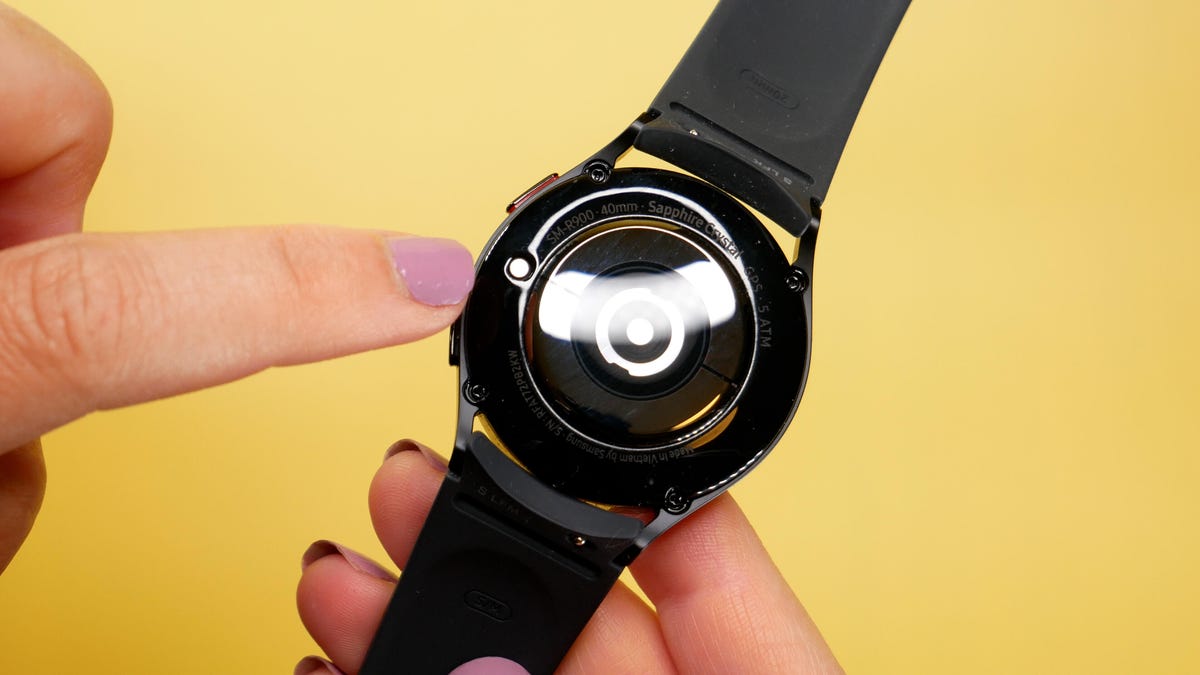
Battery life will vary depending on how you use a smartwatch, so we test battery life with a few standard tests. We see how long it generally lasts on a single charge with features that represent typical use, like the always-on display, sleep tracking and doing an outdoor workout with GPS.
Fitness and health sensor accuracy
We test the accuracy of smartwatch sensors in a couple of different ways. For example, the heart rate sensor is compared against the readings taken from a chest strap, considered the gold standard in consumer heart rate tracking. We compare readings from the watch against the strap for resting heart rate, and heart rate during a variety of cardio-based activities like running or cycling. We check to see how long it takes to connect to a GPS signal when doing an outdoor workout.
Other health sensors, like a blood oxygen sensor, are compared against a pulse oximeter for spot readings where possible.
Other smartwatches we tested
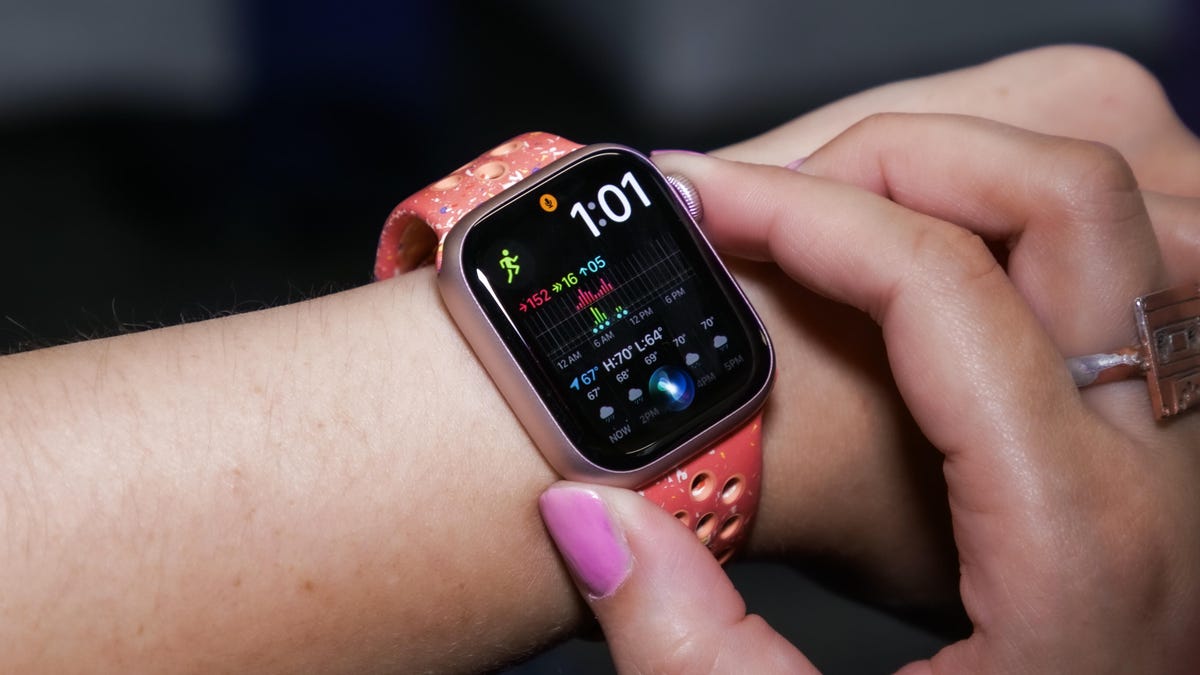
While no longer sold directly by Apple, the Apple Watch Series 9 is still a strong option if you can find it. Third party retailers often have it in stock with discounts as low as $300. You’ll miss out on the larger, redesigned screen and ultra fast charging of the newer Series 10, but it still has key health features not available on the cheaper SE, like the ECG app, temperature sensing and sleep apnea notifications.
What to look forward to in the second half of 2025
Smartwatches are only getting smarter about health, and I hope that continues; whether it’s better sensors, new metrics, or more personalized coaching, especially as more brands start leaning on AI to make sense of your data. One trend I’d love to see stick around in this year’s launches is better battery life. Smarter software and hardware upgrades like the dual CPU architecture on the OnePlus Watch 3 are finally making multiday wear feel realistic. Meanwhile, the definition of a wearable is expanding fast, with more smart rings making their debuts as well as upgraded earbud options with built-in health sensors that are already nudging into smartwatch territory. They probably won’t replace watches entirely, but they’re definitely raising the bar, and will continue giving the smartwatch category a healthy push forward.